
Published 25 June 2026
A local Landcare group fighting fire ants warns the invasive pest could cause significant, long-lasting damage to Australia's native wildlife and ecosystems if it becomes established.
The warning comes from the Cedar Grove Landcare Inc, a non-for-profit charity which actively monitors and responds to fire ant detections in the Logan area.
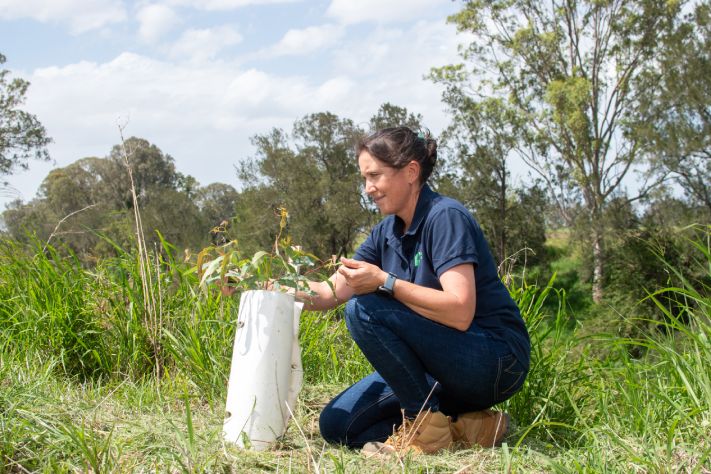
Group Founder and Director Rachel Hughes says fire ants are already disrupting local environments, preying on small animals, attacking native insects, and threatening ground-dwelling species.
'Australia being an island, and a very large one at that, has some of the most unique animals and insects on the planet,' Rachel says.
'If wildlife is pushed out of its natural habitat, it risks being driven to the brink of extinction.’
'There’s a flow on effect. If you take something out of the biodiversity chain, even something small that has an ecosystem, it impacts other species and that flow on effect keeps going.'
Landcare groups like Cedar Grove are no strangers to tackling invasive pests such as weeds and feral animals, but fire ants present new challenges.
'Before fire ants, we would do everything that other Landcare groups do,' Rachel says.
'We help our community have planting days and great events where we manage weeds or just get together and enjoy the great outdoors.
'Today, we carry fire ant treatment with us, we conduct safety checks and have protocols in place to deal with fire ants.'
The Cedar Grove Landcare Group is supported by the Fire Ant Suppression Taskforce, which helps communities self-treat fire ants until our national eradication program arrives.
Fire ants can cause population declines across many species, including:
- 45% of birds
- 38% of mammals
- 69% of reptiles
- 95% of amphibians*.
A cost-benefit analysis by Central Queensland University estimates that, if left untreated, fire ants could cause $84 million in environmental damage each year.
'Fire ants are everyone’s problem. It’s not just one organisation, or the government or Biosecurity Queensland. Everyone with a yard needs to be doing their bit to eradicate fire ants,' Rachel says.
Fire ants spread quickly. Reporting them online or by calling 132 ANT (13 22 68) is crucial to protecting our wildlife and Australia's unique biodiversity.
Watch the video
Rachel from Cedar Grove Landcare group talks about their role in caring for the local environment.
If fire ants establish in the broader ecosystems that we have, it will decimate our current populations of many of our endangered species. There's a flow on effect.
If you take something in that food chain out something small that has an ecosystem service that's significant and it's gone, well, it impacts some a different species and another specie, and another species.
So that flow on effect keeps going. The option of having a fire ants establish here is not an option. We must eradicate them.
My name is Rachel Hughes and I am the founder and director of Cedar Grove Landcare.
We do all things environmental. We help our landholders, we help our community, and we have a small community nursery here, helping trainees, local volunteers and our communities, revegetate.
Landholders in this area have been living with this for a very long time, over 20 years.
But in the last 5 to 10 years, it actually has exacerbated. It's just incrementally growing in the number fire ant nests we have.
Australia’s biodiversity is one of the most amazing on the planet.
Being an island and a very large one at that, we have some of the most unique animals, insects, you name it on the planet from koalas and echidnas, and wombats, even right down to insects.
That diversity makes us something amazing on this planet, and it's definitely something that we need to protect at every cost possible.
The impact of fire ants on the native environment is enormous, especially for those that are ground dwelling.
Anything that utilises the ground and then anything that burrows is going to be impacted by fire ants.
And if they're displaced from those areas that are currently theirs, then that's a reduction in the possible habitat for them, which reduces the species, which could in turn bring them on the brink of extinction, which we don't want.
But you have to worry about with fire ants and treating fire ants is if people are using insecticides that are not the approved bait.
Those insecticides will kill everything else within that area.
So including our own native insects and ants, which we have high biodiversity of.
But also the soil microbiology.
And we need that.
Everything has a function and it all connects to each other.
And we want to maintain that so we don't want to be using, insecticides that will cause that massive off-target damage.
We need to really stick to the ones that have been improved and just be persistent because it will work.
Before fire ants, god I haven't known it before fire ants.
We've had fire ants out here for over 20 years before we had to carry bait for conservation with landcare groups, we would go out and do everything every other landcare group does.
You go out and you help your community.
You have planting days, you have great events where you're doing weed control or you just getting together as a community, enjoying the great outdoors.
Now you have to factor in what if you have fire ants on a particular site.
You have to go and check with safety.
You have to make sure that you have your protocols in place, and you have to let people know there's potentially fire ants there.
This is everyone's problem.
This is just not one organisation’s problem, this is just not, you know, a governmental problem or Queensland Biosecurity.
This is everyone's problem.
Everyone with a yard needs to be doing their bit to get rid of these fire ants, because it's going to change our lifestyle forever.